Who Should See an Employee's Work Anniversary? Celebrations, Hire Dates, and Privacy
Celebrating anniversaries and birthdays builds culture, but a work anniversary is derived from a hire date — employment information. A practical guide to deciding who sees what in your directory, your dashboards and your digest emails.

A small gesture with a data question underneath
"Happy five years, Sam!" in the team channel is one of the cheapest, warmest things a company can do. Most HR systems make it automatic: a celebrations widget, a line in the weekly digest, a reminder to managers. Nobody thinks of it as a privacy decision.
But a work anniversary is not just a nice date. It is calculated from somebody's hire date, and a hire date is employment information. Put a list of anniversaries in front of the whole company and you have also published:
- Tenure — exactly how long each person has been here.
- Relative seniority — who joined before whom, which people often read as pay or standing.
- Who is new — including in teams where a new hire may be a sensitive replacement.
None of that is secret in a five-person startup. In a fifty-person company with several departments, it is information many people would not expect to be broadcast — and most organizations never decided to broadcast it. The widget simply did.
Birthdays and anniversaries are not the same kind of data
It helps to separate the two:
- A birthday, shown as a day and month with no year, tells colleagues nothing about someone's employment. Most people are comfortable with it being shared, and it is easy to let people opt out.
- A work anniversary is employment data wearing a party hat. It belongs with the rest of a person's employment record, and the question of who sees it should have the same answer as "who sees their start date".
A reasonable default follows from that: share birthdays widely (without the year), and show work anniversaries to the people who already have a reason to know someone's start date.
Who has a reason to know?
For most organizations, that is a short list:
- The employee themselves. It is their milestone.
- Their manager. They are the person most likely to mark it, and they already know the start date.
- Their department head. They are responsible for the team the person sits in.
- Administrators and executives. They run the organization's people records.
Everyone else can still celebrate — the manager can post the message, and the team can join in. What changes is that the system is not quietly handing every colleague a tenure table.
The three places anniversaries leak
When you tighten the rule, apply it everywhere the date appears. In practice, there are usually three surfaces, and they are often built separately:
- The dashboard or home page — a celebrations card listing the next fortnight's milestones.
- Digest emails — the daily or weekly summary, which can travel further than any screen because emails are forwarded and archived.
- Monthly or scheduled reminders — "anniversaries this month", often sent to department heads.
The classic failure is fixing the first and forgetting the other two, so the card respects the rule while the Monday email still goes to everyone. If your system lets you, check that all three read the same rule rather than each having its own.
Watch for one more edge case: a department head who has not been assigned a department yet. A rule written as "department heads see their department" can fail open for that person and show them every anniversary in the company. The safe behaviour is the opposite — no department, no department-wide view.
Respect the settings you already have
Many organizations have already made a related decision without connecting it to celebrations. If your directory is set so that other departments are hidden from regular employees, your celebrations should follow the same boundary. A birthday list that crosses departments when the directory does not is the kind of inconsistency people notice.
The same goes for private leave types: if somebody's absence is recorded as private, a "who's out" list should say "Private" to anyone not entitled to the detail — and should never include the reason they gave for being away.
A short policy you can adopt
- Birthdays: shown to colleagues as day and month only, never the year.
- Work anniversaries: shown to the employee, their manager, their department head, and administrators and executives.
- Every surface — dashboard, home page, digest emails and scheduled reminders — follows the same rule.
- Department-level visibility settings apply to celebrations too.
- Managers are encouraged to mark milestones publicly themselves, where the person is comfortable with it.
How BookYourPTO handles it
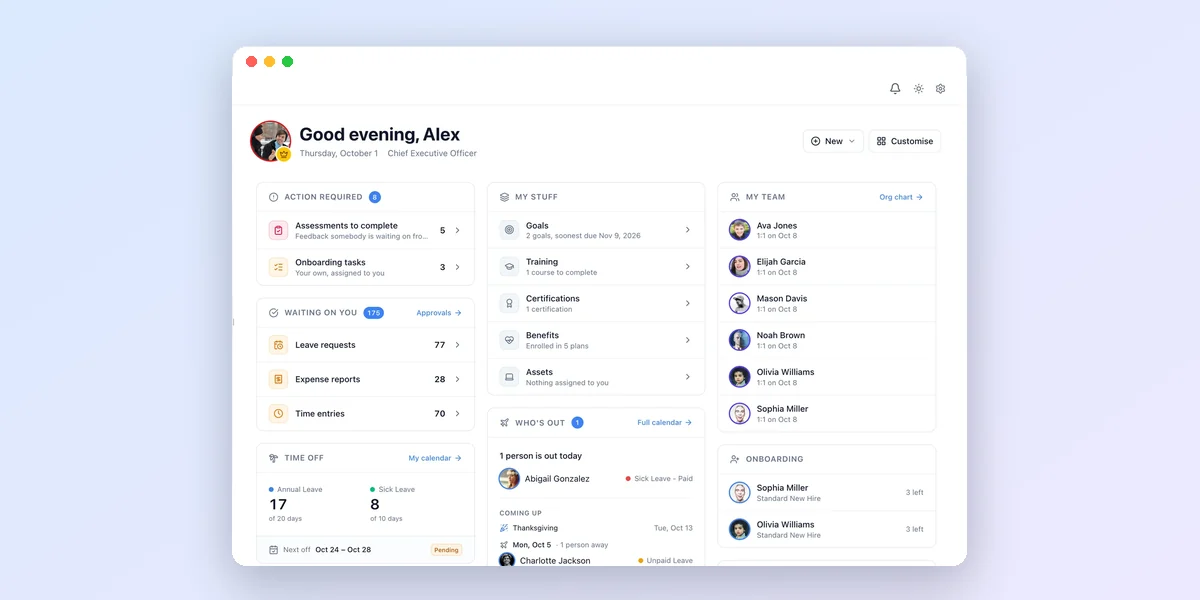
In BookYourPTO, a work anniversary is shown to the employee, their manager, their department head, and administrators and executives — on the dashboard, on the Celebrations card on Home, and in both the daily and weekly digest emails, which all read the same rule. Birthdays are shared more widely and the year is never sent. When an organization hides other departments, Celebrations and Who's Out are limited to a non-administrator's own department, and private leave types read as "Private" to anyone not entitled to the detail.
Written by
AnHourTec Team